














The role of switchgear in a wind turbine – location, types and importance

Every minute of unplanned downtime in a modern wind turbine can result in financial losses amounting to tens of thousands of euros, while the operational reliability of an entire wind farm depends on the performance of its critical components.
Today’s wind power installations are powerful and highly complex systems expected to deliver near-100% technical availability and operate at maximum efficiency. Within this demanding energy environment, switchgear plays a crucial role. It is the electrical switchgear that is responsible for the safe distribution of power, circuit protection against overloads, and continuity of supply. Discover the functions, types and location of LV electrical enclosures without which modern wind energy infrastructure simply could not operate.

What is the function of switchgear and control cabinets in a wind turbine?
The importance of advanced electrical switchgear in modern wind energy is critical. For a turbine to operate efficiently and reliably, it requires a precise division of responsibilities between two cooperating systems: power distribution and automation and control.
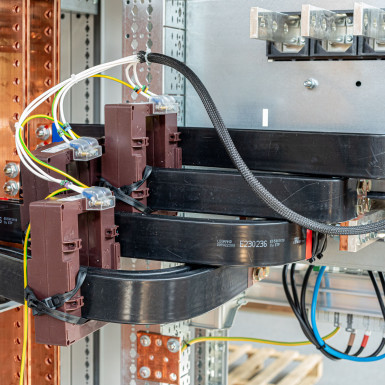
The first of these areas is handled by the switchgear cabinet, often referred to in industry standards as low-voltage switchgear (LV switchgear / LVD). Its primary role is the safe reception of current generated by the generator, protection of the installation against the effects of short circuits and overloads, and stable power supply to the turbine’s auxiliary equipment.
The control cabinet, in turn, acts as the “brain” of the entire structure. It contains PLCs, communication systems and I/O modules that continuously analyse data from sensors — including wind speed and direction, rotor speed and component temperature — and make decisions regarding turbine operating parameters.
The close integration between the switchgear and the control system ensures that the generated power is transferred safely to the grid, while the infrastructure itself operates at the highest possible efficiency.
Switchgear and control cabinets – the 5 most important functions in a wind turbine
- Safe power distribution – the switchgear ensures the efficient reception of power from the generator and its safe transmission to subsequent sections of the power supply system or transformer.
- Overcurrent and surge protection – circuit breakers, fuses and protective devices installed inside the cabinet protect costly equipment against faults and voltage spikes.
- Turbine operation and automation management – continuous control of mechanical and electrical parameters, including blade pitch adjustment systems and nacelle yaw control.
- Real-time parameter monitoring – continuous collection of diagnostic data and transmission to higher-level supervision systems such as SCADA.
- Environmental protection of components – the high IP protection rating of the switchgear cabinet protects sensitive electrical systems against moisture, vibration, dust and extreme temperatures.
Where is the switchgear located in a wind turbine?
The location of electrical cabinets depends closely on the output, dimensions and architecture of a given wind power installation:
- At the base of the tower – this is the most common location for the main switchgear and power distribution boards. Installation at the bottom of the structure significantly facilitates servicing, technical inspections and adaptation of the installation to grid operator requirements.
- Inside the nacelle (at the top of the tower) – in modern high-capacity turbines, an auxiliary LV switchgear or control module is installed directly in the nacelle. Proximity to the generator and gearbox helps eliminate transmission losses over long cable routes.
- In domestic wind power systems – in the case of a home wind turbine or small-scale renewable installation, the switchgear cabinet combined with the controller has compact dimensions and is installed at the base of the mast or in an adjacent technical room, such as a garage.
What types of switchgear cabinet designs are available?
A range of enclosure designs is available on the market and selected individually according to the requirements of a given energy project:
- Single switchgear – compact single-compartment solutions used mainly in less complex systems and micro-installations.
- Modular switchgear – advanced sectional systems that can be freely combined. They provide high flexibility and scalability for large wind farms.
- Power distribution and control cabinets – comprehensive solutions combining power distribution and automation/control sections within a single enclosure.
The future of switchgear – automation and the digitalisation of renewables
Today’s switchgear is no longer merely a passive component of an electrical circuit. In the era of digitalisation in the renewable energy sector, it is becoming an active part of smart grid infrastructure. Equipping switchgear with IoT sensors and integrating it with predictive algorithms based on AI makes it possible to implement predictive maintenance strategies.
As a result, the system can detect contact wear, fluctuations in current parameters or the risk of overheating in advance. This allows maintenance work to be planned ahead of time and eliminates the risk of costly, uncontrolled downtime.

Electris – professional prefabrication of LV and MV switchgear
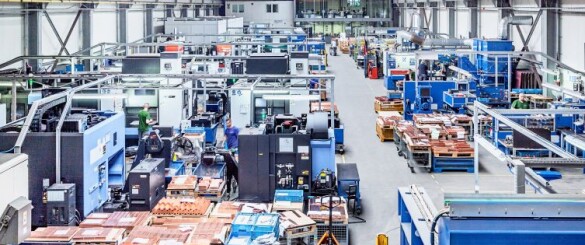
As an experienced manufacturer and technology partner, we deliver reliable solutions in the field of electrical system prefabrication and power distribution for industry and the wind energy sector. Every switchgear we manufacture meets strict quality standards and is ready to operate in demanding service conditions.
As part of our cooperation, Electris provides:
- Assembly and prefabrication of switchgear and control cabinets based on customer documentation (build-to-print);
- Engineering support and optimisation of component design in line with production technologies;
- Full integration of electrical systems tailored to the requirements of the renewable energy sector;
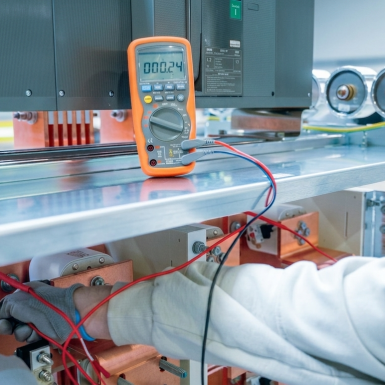
- Rigorous quality testing completed with an official factory acceptance test (FAT) report;
- Assembly in accordance with EN IEC 61439, ensuring resistance to electrical loads and minimising the risk of failure, fire or electric shock;
- Production flexibility – efficient execution of both dedicated series and large-scale projects.
Are you looking for a reliable partner in switchgear prefabrication for the wind energy sector?
Get in touch with the Electris team and find out how our solutions can help secure the continuity of operation of your installation.
Sources:
FAQ – The role of switchgear in a wind turbine
We would be happy to
discuss your needs.
Write to us so that we can prepare
a dedicated proposal for you. Ask for a quote.