

















Quality testing in cabinet and switchgear prefabrication – which tests guarantee installation safety and reliability?
In modern industry and the power sector, both the switchgear cabinet and the control cabinet must meet highly demanding requirements in terms of safety, reliability and electromagnetic compatibility.
For this reason, the professional prefabrication of electrical equipment such as electrical switchgear or an electrical control cabinet does not end with component assembly. A crucial stage of the process is multi-stage quality and safety testing, which confirms correct workmanship and readiness for operation in demanding industrial conditions. Which tests matter most, and what do they involve?

Standards and requirements in switchgear and control cabinet prefabrication
At the outset, it is worth noting that the prefabrication of equipment such as switchgear cabinets and control cabinets must be carried out in strict accordance with applicable international standards and EU directives. In practice, the manufacturer is responsible not only for the quality of individual components, but for the complete assembled unit and its safe, reliable operation as a whole.
The key standard for low-voltage systems is the multi-part EN 61439 standard series, which replaced the former EN 60439 and defines the requirements for low-voltage switchgear and controlgear assemblies. It covers, among other things, resistance to short-circuit currents, including dynamic and thermal withstand, permissible temperature rise, and the correct air and creepage clearances. This means that every switchgear cabinet and control cabinet must be designed and tested so that it does not fail under overload or short-circuit conditions. For higher-voltage equipment, such as MV switchgear, the dedicated standard is EN 62271-200.
Other important technical standards and European directives also apply:
- EN 60204-1 – Safety of machinery. Electrical equipment of machines.
- EN 60529 – Degrees of protection provided by enclosures (IP code).
- EN 62262 – Degrees of protection against external mechanical impacts (IK code).
- EN 60664-1 – Insulation coordination for equipment within low-voltage systems.
- European directives: LVD (Low Voltage Directive), EMC (electromagnetic compatibility) and RoHS.
Every stage of electrical cabinet prefabrication and assembly should be supported by the appropriate documentation, including the relevant declaration of conformity and design verification.
Quality and safety testing in switchgear and control cabinet production
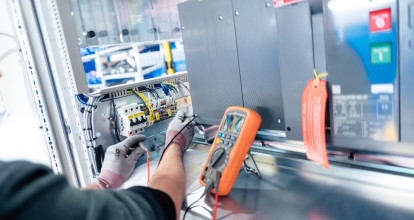
The best confirmation that a switchgear cabinet or control cabinet has been manufactured correctly is proper testing. These tests should be integrated into the production process and should cover both raw material verification and routine post-assembly testing of the finished product.
At Electris, as part of our factory acceptance testing (FAT), we offer:
- Point-to-point connection testing – verification of circuit continuity and wiring correctness in full compliance with electrical schematics. This helps eliminate assembly errors before voltage is applied.
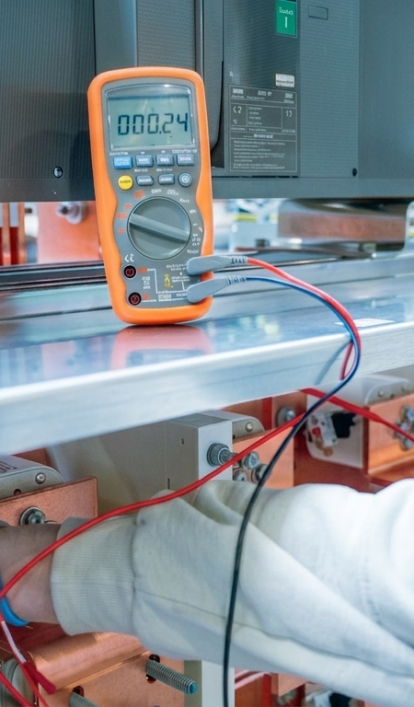
- Continuity and protective earthing effectiveness measurements – testing of the resistance of the protective earth (PE) circuit. This ensures proper shock protection by enabling rapid disconnection of the power supply under fault conditions.
- Insulation testing and high-potential (Hi-Pot) testing – measurement of insulation resistance and verification of dielectric strength using high test voltage. These tests help detect micro-breakdowns, damaged insulators or incorrect insulation clearances. This applies to equipment such as LV switchgear and, under appropriately higher voltage conditions, MV switchgear.
At the end of the process, a factory acceptance test (FAT) is carried out, resulting in an official report confirming compliance with the customer’s requirements and the technical documentation. In high-volume production, the PPAP (Production Part Approval Process) procedure is also used to ensure repeatability and process quality stability.
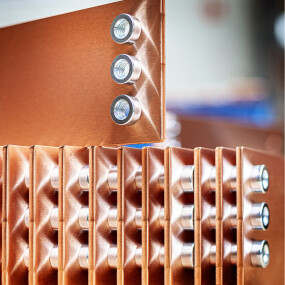
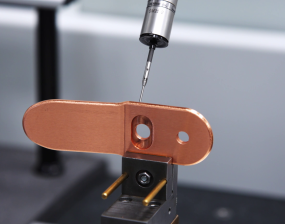
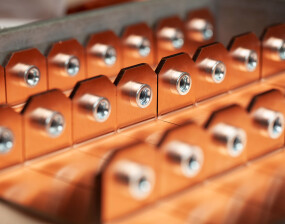
In addition, established manufacturers, including Electris, use advanced measuring equipment and coordinate measuring machines (CMM) for precise inspection of busbar geometry and other mechanical components.
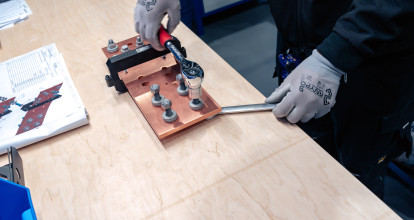
Factors affecting the quality of switchgear and control cabinets
High-quality prefabrication is the result of a well-thought-out engineering process. A key role is played by design based on DfM (Design for Manufacturing) principles, which makes it possible to optimise the arrangement of equipment, busbar systems and cable routes already at the digital design stage using CAD/CAE tools.
At Electris, every project undergoes detailed engineering verification. We optimise designs for production efficiency, introducing any necessary corrections to internal layouts and mechanical components.
This comprehensive approach ensures that the prefabrication of electrical equipment at Electris is a fully repeatable, safe and engineering-driven process.
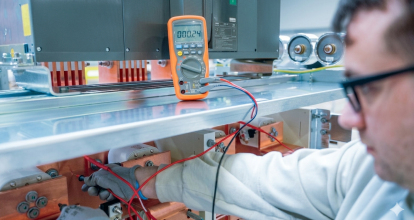
Electris Services §– comprehensive prefabrication of control and power distribution systems
Benefit from Electris expertise. Thanks to advanced production methods, strict compliance with technical standards and a full scope of acceptance testing, we deliver assembled products manufactured in line with our customers’ requirements.
Get in touch with us and send us your project details for analysis. Write us on sales@electris.pl
FAQ – Quality testing in cabinet and switchgear prefabrication
We would be happy to
discuss your needs.
Write to us so that we can prepare
a dedicated proposal for you. Ask for a quote.